
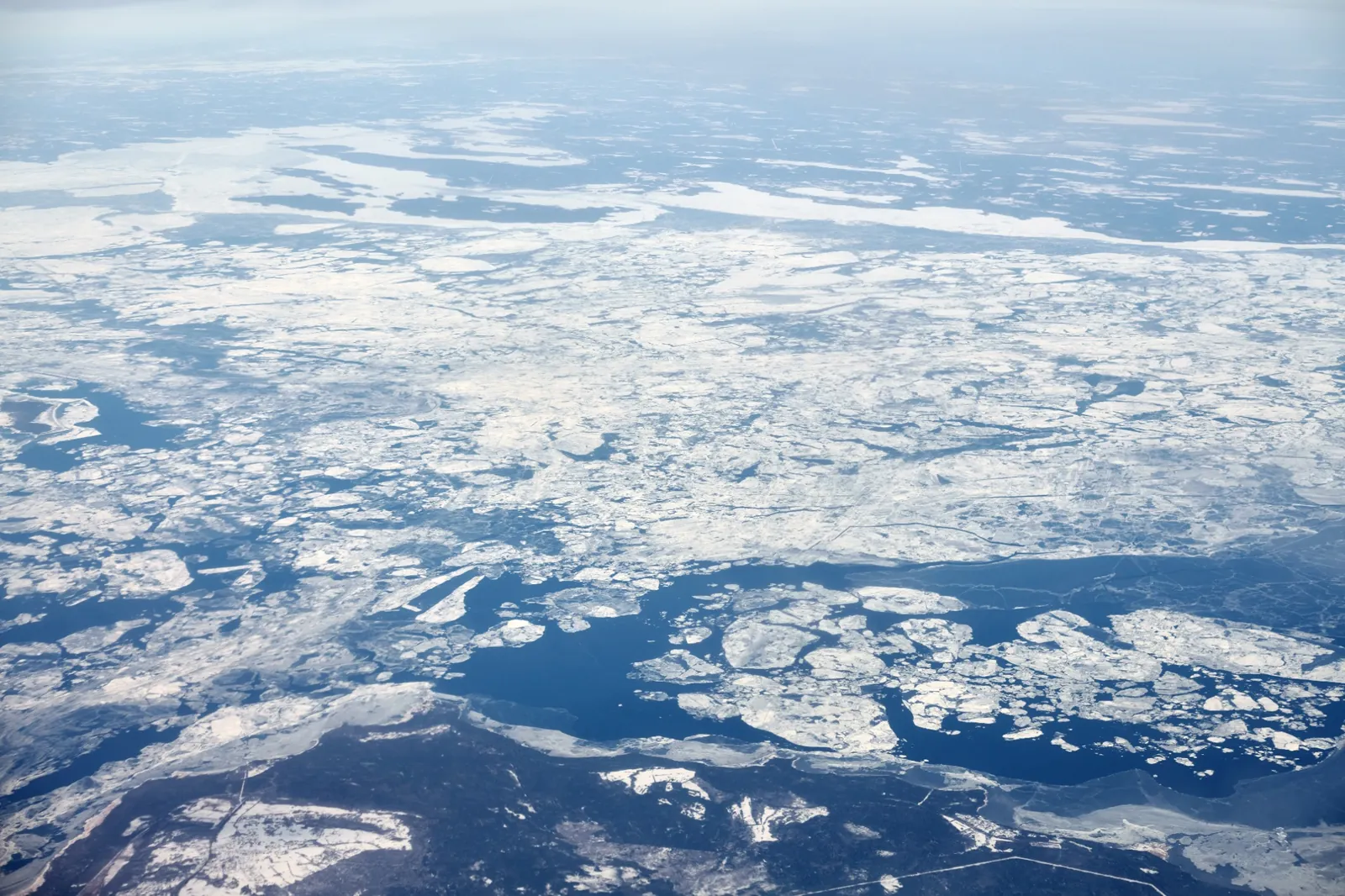
A new assessment places ice, snow and permafrost within a common framework of planetary risk. Its warning is serious, but understanding it requires separating precautionary boundaries from predictions of sudden collapse.
A mountain glacier, Arctic sea ice and frozen ground may appear to belong to different environmental stories. They occupy different places, respond at different speeds and affect people through different mechanisms. A study published this week asks readers to consider them together. Its central proposition is that the frozen parts of the planet perform connected functions whose deterioration cannot be understood adequately as a collection of isolated regional losses.
Published online in Science on 12 November, the assessment proposes a safe operating space for the cryosphere: the Earth’s ice sheets, glaciers, sea ice, snow and permafrost. The authors conclude that the system has breached, or is committed to crossing, their proposed bounds. This is a synthesis of evidence and a framework for assessing risk. It is not a newly observed global collapse occurring on the publication date.
The distinction is explicit in the paper. Its boundaries are precautionary and risk-based, rather than direct estimates of physical tipping points. The authors assess departures from reference conditions, the loss of stabilising functions and changes that may continue because parts of the system have not yet adjusted fully to the present climate. Their conclusion therefore combines what has already happened with an assessment of longer-term commitments.
That wording is demanding because ordinary language encourages a simpler interpretation. A boundary sounds like a line beyond which the next event must be catastrophic. In this framework, it marks a condition beyond which the risk to a stable Earth system has become less acceptable. Crossing it does not identify a single date, a uniform regional outcome or the speed at which every consequence will unfold.
The distinction between sea ice and land ice shows why a common framework still needs careful internal differentiation. Sea ice forms in the ocean. Much of it is already floating, so its melting has a very different direct effect on sea level from water arriving from glaciers and ice sheets on land. NASA’s explanation emphasises this contrast. Treating all ice loss as the same physical process makes the resulting risk harder to understand.
Sea ice nevertheless matters greatly to the climate system. Bright ice reflects more incoming sunlight than the darker ocean exposed when it retreats. The National Snow and Ice Data Center describes how this contrast can reinforce warming: a surface that absorbs more energy can contribute to further melting. The importance of sea ice therefore extends beyond the question of how much water its disappearance adds to the sea.
Permafrost introduces another mechanism. Frozen ground contains organic material that can become available for decomposition as conditions change. Microbial activity can release carbon dioxide and methane. NASA research described in August examined a near-freezing stage during seasonal transitions, showing why the timing and moisture conditions of thaw matter. That work is background to this week’s assessment, not a separate discovery made in November.
These mechanisms explain why the study’s scope reaches well beyond polar landscapes. Changes in the frozen Earth can influence water supplies, coastal exposure, infrastructure and the wider climate. The Stockholm Resilience Centre’s account of the research highlights those connections and the particular vulnerability of mountain, coastal and low-lying communities. The centre participated in the study, so its account explains the authors’ position rather than independently testing it.
For a community downstream of a glacier, the practical question is how water availability changes across seasons and years. For a coastal authority, it concerns the conditions a defence or drainage system must withstand over its lifetime. For infrastructure built on frozen ground, the stability of the supporting surface may be central. These are distinct planning problems, even when they originate in connected environmental change.
A global framework cannot resolve them by itself. A municipality cannot insert a planetary boundary directly into the design of a bridge and obtain a complete engineering answer. It needs local observations, an appropriate range of scenarios and an understanding of the asset’s vulnerability. The global assessment changes the context in which those decisions are made; it does not replace the detailed work.
This is particularly important when public discussion moves from scientific risk to financial cost. A building, road or power system can remain in use for decades. Its performance may depend on environmental conditions that change during that period. Evaluating only the climate at the moment of construction can therefore create a misleading impression of affordability. A lower initial price may be followed by higher maintenance, disruption or replacement costs.
Uncertainty does not make that calculation impossible. It changes how it should be approached. Decision-makers can examine whether a project remains useful under several plausible conditions, whether it can be adapted and which failures would be especially costly. They can also distinguish reversible choices from those that lock a community into a vulnerable location or design. The relevant response to uncertainty is disciplined comparison.
There is a corresponding need for care in reporting the science. A dramatic global statement can draw attention while encouraging the mistaken belief that every local outcome has already been determined. Conversely, pointing to uncertainty in a precise threshold does not invalidate well-established physical mechanisms. The proper distinction is between confidence about the direction of an effect and uncertainty about its magnitude, location or timing.
The new framework itself remains open to refinement. The authors acknowledge limitations in observation, reconstruction and modelling. Different components have different reference records and response times. Those qualifications belong within the finding, rather than being treated as an embarrassing addition. A framework intended to guide precaution should be judged partly by how transparently it describes the uncertainty around its own boundaries.
The governance problem is equally layered. Some actions can reduce local exposure, such as changing a design or improving monitoring. Others address the drivers of further warming and require coordination across borders. Neither level makes the other unnecessary. Adaptation can protect people while remaining limited by the scale of environmental change; reducing the underlying pressure can limit future harm without reversing every change already under way.
For businesses, this means identifying a physical dependency before adopting a general climate narrative. A tourism operator, food processor, insurer and transport company may encounter cryosphere change through different parts of their operations. Useful analysis connects a specific dependency with a credible source of evidence and an actionable decision. A broad declaration of awareness provides little protection if the operational exposure remains unidentified.
The study’s contribution is to make those separate concerns visible within one Earth-system argument. Its warning should neither be diluted into a vague appeal nor inflated into a timetable it does not provide. The frozen Earth helps sustain conditions on which societies have built their expectations. As those conditions change, responsible planning begins with understanding which expectations can still be relied upon, which need revision and how much further disruption can be avoided.
The Deeping Editorial Team