
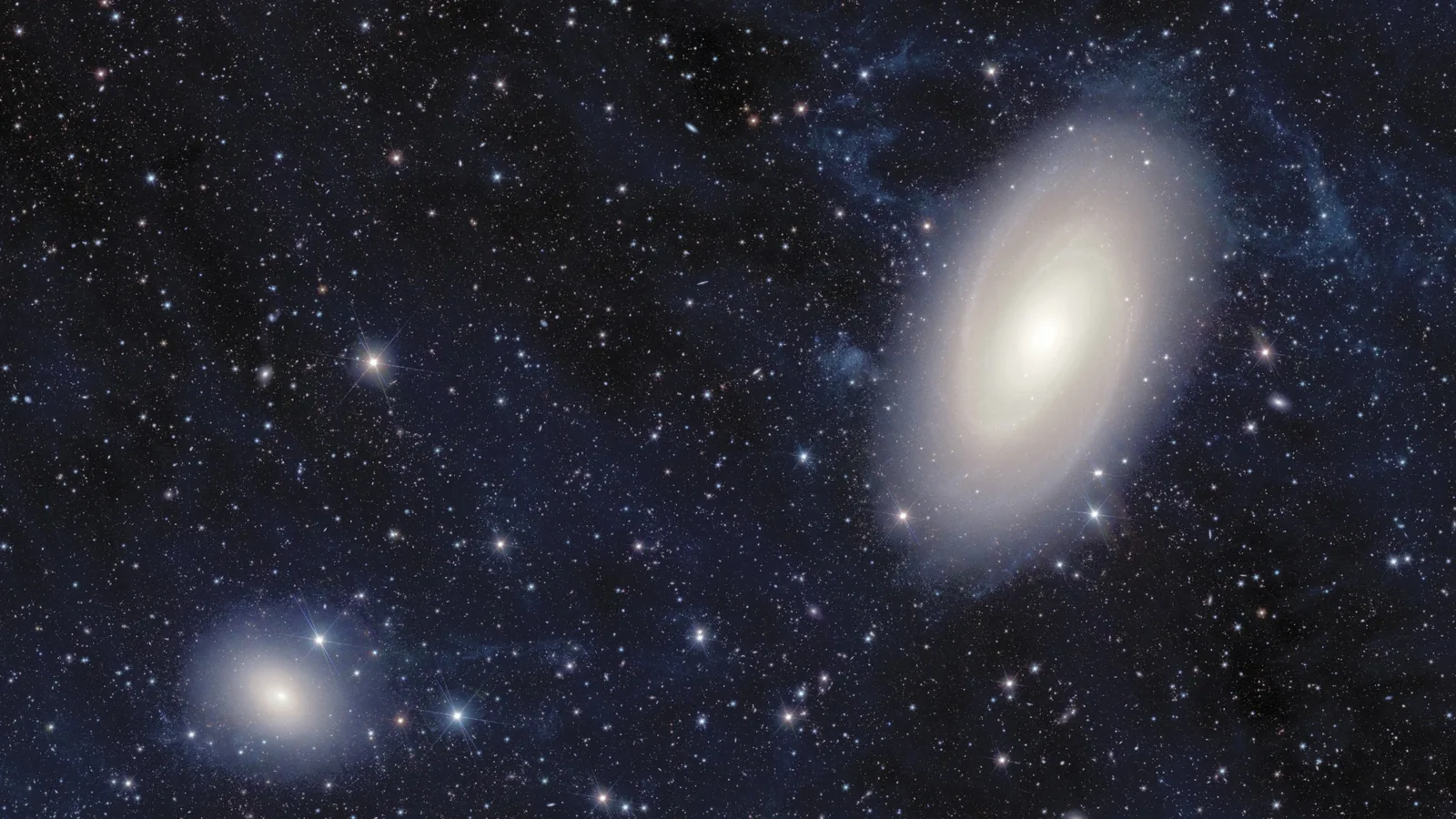
The space telescope’s first major data release gives researchers an extraordinary new resource. Understanding the dark Universe will depend on what happens between collecting the light and trusting the measurement.
A beautiful astronomical image offers an immediate reward. A reliable measurement asks something more of the viewer: patience with calibration, selection and uncertainty. Euclid’s first major data release contains both kinds of promise. Its images make the scale of the Universe newly tangible, while its catalogues create the possibility of testing ideas that cannot be resolved by looking at a striking galaxy alone.
On 12 November, the European Space Agency released DR1-Foundation, comprising approximately thirteen months of Euclid observations. ESA says the release captures light from more than a billion objects, including over 900 million galaxies, and contains spectra from more than 160 million sources. These are observations assembled into a scientific resource. They are not a declaration that dark matter or dark energy has been directly identified.
The timing deserves particular care. The publication happened this week; much of the light was recorded earlier. ESA’s accompanying northern mosaic, for example, brings together observations collected in autumn 2024 and spring 2025. A data release is therefore an event in the organisation and availability of evidence, rather than a claim that every object was observed on the day its image became public.
There is another important boundary around the announcement. The collaboration’s overview paper, submitted to arXiv on 12 November, describes DR1 as a two-part release. Images, spectra and catalogues arrive now; shear measurements and higher-level products required for cosmological analyses are scheduled for June 2027. The paper is a preprint intended for a specialist journal issue. Its description establishes the collaboration’s release plan, not independent certification of future scientific conclusions.
This staged approach explains why the most accurate headline is also the more interesting one. Euclid has made a large new body of evidence available while retaining substantial work between that evidence and its central cosmological tests. The value of the release lies partly in allowing researchers to inspect, use and challenge the material from which those tests will be built.
The scientific problem begins with an imbalance between what can be seen and what appears to influence the Universe. Astronomers study the gravitational effects associated with dark matter and the expansion history associated with dark energy. These terms describe different problems. Euclid aims to examine them through the distribution of galaxies and the way their light has been affected during its journey. It is measuring consequences from which properties of the underlying system may be inferred.
One method is weak gravitational lensing. Matter between a distant galaxy and the telescope can subtly alter the apparent shape of the galaxy. The effect on any individual object is difficult to distinguish from the shape it already had. Across many objects, however, statistical patterns can help reveal how intervening matter is distributed. ESA’s explanation of the method emphasises that this mapping also contributes to the study of cosmic evolution.
That makes measurement quality unusually consequential. A small distortion introduced by an instrument or processing method can resemble part of the signal researchers want to study. Increasing the number of galaxies reduces some forms of uncertainty, but it does not automatically remove a shared bias. A billion measurements made with the same unrecognised error can produce a very confident mistake.
This is why calibration is a central scientific activity. Researchers must understand how the telescope responds, how processing changes the observations and which objects enter a catalogue. The selection question is especially important. If some kinds of galaxy are easier to detect or measure than others, the resulting sample cannot simply be treated as an unfiltered population. Knowing what was missed helps determine what the observed pattern means.
Spectra provide another route into the problem. By separating light into its wavelengths, researchers can identify features whose displacement helps estimate redshift. In cosmology, redshift carries information about the expansion of the Universe and, within a model, about distance. Images and spectra therefore contribute different pieces to a three-dimensional account. Neither should be described as a complete map without specifying the assumptions and processing involved.
The scale of the release makes those relationships accessible to a broader research community. Oxford’s account describes coverage of roughly 1,900 square degrees, around fourteen per cent of the area planned for the six-year mission. The comparison is useful because it conveys both achievement and incompleteness. This is already a substantial survey, yet it remains an instalment in a longer observational programme.
Public access also changes who can ask questions of the evidence. A mission may be designed around a central scientific objective while producing material useful for many other investigations. The eventual range of discoveries need not be limited to what appeared most important before launch. That is one reason to value the catalogue and its documentation as infrastructure, rather than judge the release solely by whether it delivers an immediate answer to its largest question.
Access alone, however, does not guarantee equal participation. Large datasets require computing resources, specialist knowledge and time. A researcher’s ability to download material is different from an institution’s capacity to process it responsibly. Documentation, usable tools and transparent methods help turn formal availability into practical scientific opportunity. Their contribution is less visible than a telescope, but it shapes who can produce knowledge from the telescope’s work.
For technology businesses, the mission illustrates the importance of systems that preserve meaning across a long processing chain. Sensors, communications, storage and software must work together without losing track of how a result was obtained. It would be speculative to assign a commercial return to every technique involved. The demonstrated lesson is more specific: sophisticated hardware becomes scientifically useful through equally demanding work on data quality and interpretation.
There is a public-finance argument here too. Fundamental research should be assessed honestly on its own objectives, including the knowledge it can create and the capabilities required to create it. Promising an immediate consumer application for every astronomical investment can weaken that case by attaching certainty where none exists. A society can reasonably fund an attempt to understand the Universe without pretending that its principal justification is a product arriving next year.
The most revealing future results will consequently explain their limitations as carefully as their findings. Which data were included? How were alternative processing choices tested? How sensitive is a conclusion to assumptions about the observed population? Agreement with an established model would be meaningful only if the measurement could also have exposed a departure. A surprising result would deserve the same scrutiny before being presented as a revolution.
Euclid’s release offers a timely corrective to the idea that discovery occurs at the instant a machine produces more information. Scientific progress also occurs when information becomes traceable, comparable and open to criticism. The billion-object sky matters because it creates a much larger space in which explanations can be tested. Its deepest contribution will emerge through the patient work of deciding which explanations survive.
The Deeping Editorial Team
Credits
ESA/Euclid/Euclid Consortium/NASA, image processing by J.-C. Cuillandre and E. Bertin
Licentie
ESA Standard Licence